Tuesday, August 20, 2013

The Carnivorous Plants of Florida

Pitcher plants of the genus Sarracenia
catch insects in hollow fluid-filled
leaves, and have large red, yellow, or
pink flowers.
I live in Florida, and was delighted to find out a number of years ago that we host here the greatest concentration of carnivorous plants in the United States. As the name implies, carnivorous plants capture digest, and consume animals, mostly small animals like insects.  Everyone knows the famous venus fly trap (Dionaea muscipula), which snaps shut quickly around an insect that touches its sensitive trigger hairs.  That is one species that unfortunately does not grow naturally in Florida, though I've heard rumors of carnivorous plant enthusiasts secretly planting it in some of our bogs that may be similar to its native habitat in North and South Carolina.

What we do have here are six species of pitcher plants (Sarracenia), five species of sundew (Drosera), six species of butterwort (Pinguicula), and 14 species of bladderwort (Utricularia).  Each is different in how it catches its prey.


Sarracenia flava is known to produce an alkaloid
drug that renders insect prey unable to crawl out of
the trap.
The opening of the pitcher invites insects with mottled
coloration and prevents their escape with small, slippery
hairs.
The pitcher plants have inflated, hollow leaves that fill with water.  Insects fall or slide into these pitchers, often attracted by bright colors, nectar or scent.  The walls of the pitchers are slippery due to wax or downward pointing hairs, so that insects that fall in cannot crawl back out.  At least one species, S. flava, has been found to secrete an alkaloid drug that inhibits the insects' ability to find their way out.  Some pitchers produce digestive enzymes, others rely on bacteria and fungi to breakdown the animal tissues.  The nutrients released can then be absorbed by the cells lining the chamber.  Some of our Sarracenias, such as S. purpurea and S. leucophylla, are wide open to rain water, which keeps them full at least during the rainy season.  Others have lids, that keep out some of the rain, or curved tops that keep out most of the rain (S. minor, S. psittacina).  These latter may be keeping a tighter control on the concentration of digestive fluids, and secrete fluids into their chambers from their own tissues.
Sarracenia purpurea collects rainwater to fill its traps.  This is the most widespread species,
extending from the Florida panhandle all the way up into Canada.


The traps of Sarracenia psitticina lay along the ground and when flooded
can catch small fish and other aquatic animals.
Sarracenia leucophylla occurs in the Florida panhandle and neighboring states,
 like most of the other species.


Sarracenia minor has a curved top that limits the amount of rainwater that can get into the trap.  This is the only species occurring south of the Florida panhandle region, and is found as far south as Hillsborough and Highlands Counties.
The long, grayish strands in this boggy roadside
are leaves of Drosera tracyi.
Drosera capillaris is common on wet
sandy slopes throughout Florida.
The leaves of sundews are covered with conspicuous glandular hairs.  Insects get caught in the sticky secretions and then are digested by enzymes in the secretions.  Two species (Drosera tracyi and D. filiformis) with long, slender leaves are found in the far north of the state.  The others have roundish leaves.  Drosera capillaris is abundant throughout the state, quickly colonizing marshy areas around bodies of water (see To self or not to self, the story of Drosera capillaris on the Botany Professor main page). D. brevifolia is less common, but appears to be tolerant of slightly drier soil.  D. intermedia, with longer leaves, lives in standing water.
Drosera brevifolia is similar to D.
capillaris, but flowers tend to be
larger and there are sticky glands
on the flower stalk.
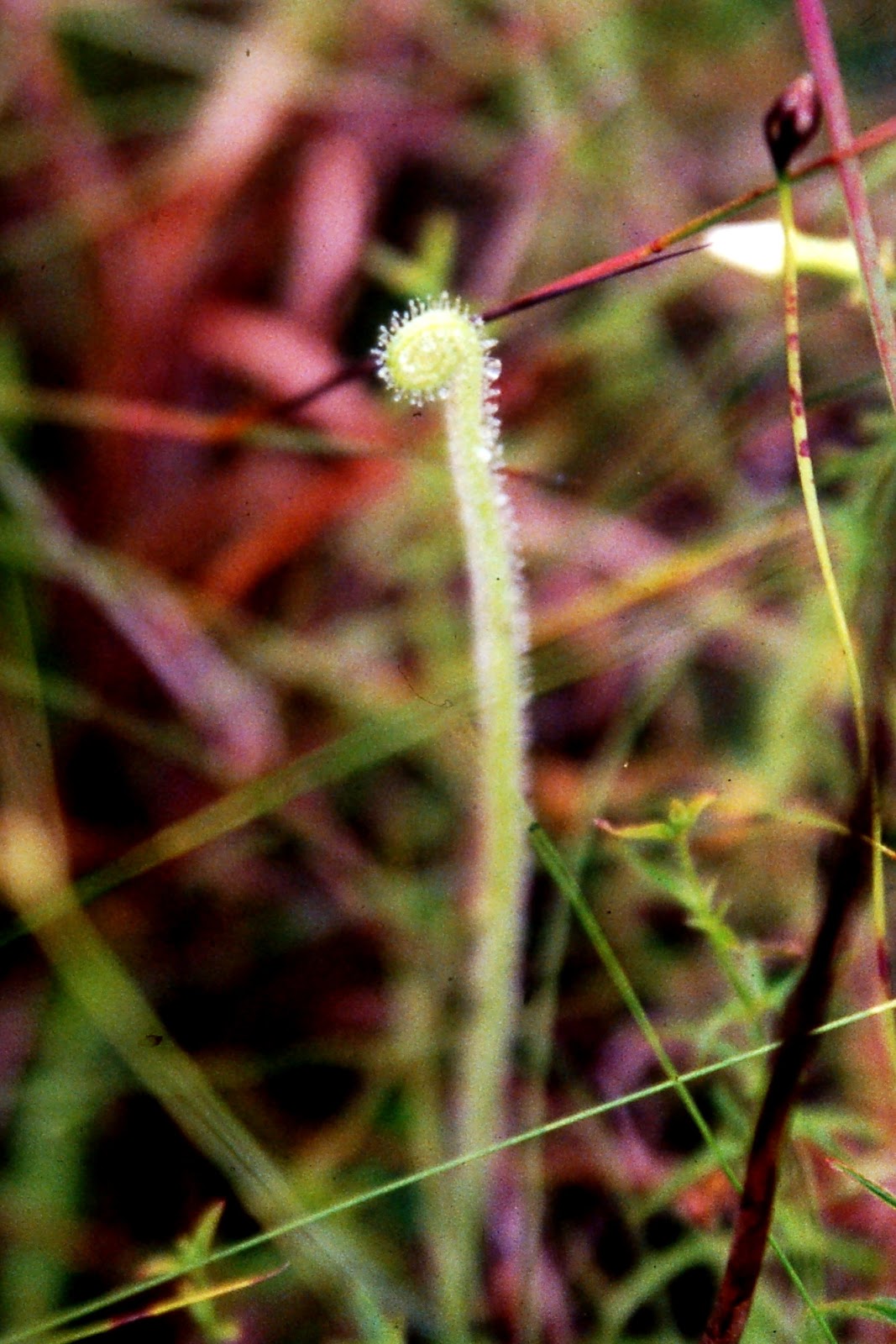
The leaves of Drosera tracyi and D. filiformis
unroll like the fiddleheads of a fern frond.

Pinguicula pumila is common in central
Florida and comes with white, bluish, or
purplish flowers.
The traps of Pinguicula are simple, sticky
leaves.
In the butterworts (Pinguicula), the leaves are covered with short glands which give them a sticky, fly-paper like coating.  The flowers are variously yellow, white, blue or violet, usually with a conspicuous nectar spur, and they live in wet to boggy soil.

Pinguicula caerulea has sky blue flowers.


The flowers of Utricularia inflata emerge from
star-like floating rosettes.  Large, highly-
dissected trap-bearing leaves are beneath.
A large population of Utricularia inflata
in a central Florida cypress swamp.
Utricularia subulata grows on wet sand,
often near Drosera capillaris.
Utricularia gibba is invisible until it sends
up its tiny yellow flowers.
The bladderworts (Utricularia) are the most numerous of Florida carnivores, with 14 species.  They get their name from the tiny bladder-like traps on their underwater or subterranean leaves.  These traps create a partial vacuum by actively pumping water out.  when tiny crustaceans brush against sensitive trigger hairs, they are sucked into the traps where they are digested.  Utricularia floridana, U. foliosa, U. inflata, and U. radiata are relatively large underwater plants, with just their flowers sticking up into the air.  U. olivacaea forms fine floating mats with tiny white flowers.  The others form their masses of traps in wet soil.  Bladderworts are cousins of the snapdragons and have similar yellow or purple flowers.


Monday, June 10, 2013

Springtime in New Mexico

Winter was not over yet in the Sangre de Cristo Mountains near Santa Fe.
Fifteen years ago, my wife had business in Santa Fe, New Mexico, and so I tagged along with camera in hand.  It was April, and I was hoping to find some signs of spring.

The famous Rocky Mountain aspens
(Populus tremuloides)
were still bare and snowbound.

At first it looked rather barren.  There had not been a lot of rain recently, and I wondered whether there was in fact a spring (botanically speaking) in the semi-arid parts of the state.  A little research on the internet shows that there is much more rain in the summer and fall than in the winter and spring.

At the Rio Grande Botanical Garden,
native redbud (Cercis) trees are
paired with cultivated pansies.
Tulip species from the Mediterranean
region were a highlight at the botanical
garden.
A quick run into the local mountains, the southern tail of the Rockies, confirmed that it was too early.  Snow still covered large areas, and the famous Aspen trees were still bare. So I began poking around the Rio Grande valley, Albuquerque basin and the mesas around Santa Fe, and  managed to find quite a lot. There were moist spots here and there with colorful annual and perennial herbs, and some plants that apparently didn't care whether it had rained recently in the drier areas.  Of course, there was plenty of color to be had at the Rio Grande Botanical Garden in Albuquerque, much of it not native, but nevertheless a welcome oasis in this dry region.

At Bandelier National Monument along the Rio Grande, the cottonwoods, relatives of the aspens, were just coming into bloom.  Hummingbirds buzzing and fighting with one another around the feeders at the visitor's center were a great treat.  Perhaps they also fed on the currant flowers that were also coming into bloom. Along the river were also thickets of Tamarisk, a shrub with scale-like leaves and tiny flowers.
Hummingbirds put on a constant show around the feeders
at Bandelier National Monument.
Low to mid-elevations around Santa Fe were dominated by pinyon pines,
and appeared to be quite dry in April of 1998.

Currants, or Gooseberries (genus Ribes) are shrubs growing along rivers.

The flowers of the cottonwood tree, Populus fremontii, were
emerging in April
Penstemon pseudospectabils in the river floodplain.
The male flowers of the box elder
(Acer negundo) dangle on long stems.
The wind will disperse their pollen with
a small chance that some will land on
a female flower.

Astragalus missouriensis provides bright color along
roadsides.

Descurainia richardsonii is in the mustard
family.

Feather dalea, Dalea formosa, in the legume family, is common along
roadsides
Astragalus mollissimus, also a legume.
The prairie evening primrose, Oenothera albicaulis
Melampodium leucanthum, or plains blackfoot, is in the sunflower
family, Asteraceae
A horsetail, genus Equisetum, is a distant
relative of ferns
Spectacle pod, Dimorphocarpa wislizeni, is a member
of the mustard family, Brassicaceae
Waterleaf, Nama hispidum


Friday, March 22, 2013

Papua New Guinea 6. New Britain

Off the northeastern coast of New Guinea lie the large islands of New Ireland and New Britain.  Some interesting palms had been found there by earlier explorers, and so I had wanted to go for years.  I finally got there in 1989, accompanied by my old friend Heinar Streimann and a couple of my students from the University of South Florida.  Though my main goals were thwarted by a combination of washed out roads, governmental red tape, bad weather, and the threat of a volcanic eruption, it turned out to be an interesting trip.

Flying by New Britain in 1972, I caught this glimpse of steam
rising from one of New Britain's volcanoes (Pago?)
The island is largely volcanic in origin, and several volcanoes are active.  An eruption in 1994 devastated the capital city of Rabaul.  One of the roads I had hoped to take had been blocked by volcano-related rock slides, so we were forced to work in a different part of the island.

We took an old logging road up into the central part of the island.  It was passable, but overgrown in parts by morning glory and other vines.  Logging roads are always sad reminders of forest destruction, but we managed to get into some decent forest.


Later, we wandered around on some other roads, apparently avoiding disaster without knowing it.  We found out from one of the local hotel owners that some tourists had been killed by a gang of thugs in the area we'd just toured only a week before.  Also there was an outbreak of Dengue fever, a mosquito-borne disease somewhat nastier than malaria, in the area.  So we had also by dumb luck avoided the mosquito thugs of the area.

As always, most of the local residents were friendly and bemused by the strange antics of the pale-faced scientists.  We were even invited to a pig roast by a relative of one of our botanical assistants.  We were able to collect a couple of new palm species.  One I later named Ptychosperma hentyi, in honor of one of the long-time resident botanists, Ted Henty.  It was later moved to the genus Drymophloeus by one of my younger colleagues.  Unfortunately I don't seem to have gotten any decent photographs of this interesting palm which has very broad, fan-shaped leaflets. The other new species was a Heterospathe, which I named H. parviflora, for its very small flowers.
One of our assistants holds the leaf and infructescence of Heterospathe parviflora.

Along the way some other curiosities included a specimen of the odd gymnosperm genus Gnetum.  This is one of three genera of the order Gnetales, which is now known to be an offshoot of the Conifers.  The other two genera are Ephedra (source of the drug ephedrine) and Welwitschia, the strange dweller of southwestern African deserts that produces only two ribbon-like leaves during its lifetime.
A reproductive shoot rises from the
straggling stem of a Gnetum species.
This interesting inflorescence appears
be something in the Solanaceae.

A tiny Dendrobium, possibly a form of D. bracteosum.


The widespread Passiflora foetida was also common along
the logging road.

A load of oil palm fruit awaits pickup beside the highway.
Much of the lowland forest in New Britain has been
converted to oil plantations.
Children always greeted us with smiles and laughter.
We were forced to leave the island by heavy rainfall that was predicted to last a week or more, intrigued by what we had found, but disappointed that we hadn't been able to do more.

In a local village, a man prepares roofing panels from coconut
palm leaves.
Our camp along the logging road.  Heinar Streimann is in the center, Kathy Kuhlman at the far right.