Showing posts with label Carnivorous plants. Show all posts

Wednesday, January 6, 2016

Australia 3. The Incredible Carnivores

Carnivorous plants, such as the clump of
Cephalotus at the lower right, often grow
in boggy marshes.
Everyone is fascinated by carnivorous plants.  Earlier, I documented the species found in Florida, but the numbers there pale in comparison with those to be found in Australia. According to the epic 3-volume work on Australian carnivores by Allen Lowrie (1987, 1989,1998), there is one unique pitcher plant, Cephalotus follicularis, three species of Byblis, 19 species of Utricularia, one species of Nepenthes, and the one aquatic species, Aldrovanda vesicularis.   However, the king of carnivores, in Australia and the world as a whole, is the genus Drosera - the sundews.  Lowrie lists just over 100 species, many divided into subspecies. The number of recognized species has increased over the years.  Florabase now lists 110 species for the state of Western Australia alone, which is where the majority of Australian species reside.

Cephalotus follicularis is a pitcher plant endemic to Australia.  It is not related
to the pitcher plants in the genus Nepenthes
One of my goals in Australia was to see as many of the sundews as possible, and maybe even to see Cephalotus growing in the wild.  With only a couple of weeks in Australia in October of 1998, I of course could only skim the surface of this vast assortment of carnivorous plants.  I had to confine myself to the southwestern corner of the country for my primary exploration, but later had an outing in the Snowy Mountains of New South Wales with my friend Heinar Streimann. Sundews were abundant everywhere, however.  Whenever I stopped my car beside the road, I had to step carefully to avoid these prolific, though often tiny plants.
Many species of Australian sundews
produce their trap leaves along upright
stems.
The bright orange flowers of Drosera hyperostigma are larger than the rosettes
of trap leaves that produce them.
And I did find Cephalotus!  At the Botanic Gardens in Perth, I asked where I might find them, and they referred me to a nurseryman who was propagating them for the hobbyist trade.  I visited his nursery and saw the baby pitcher plants being groomed for the market.  The owner was at first reluctant to reveal the location of a wild population, but I assured him that the only thing I would take was photographs, and he relented.

Drosera macrantha climbs by using its sticky traps to grab onto supporting shrubs.
After I drove to the location and climbed over a locked gate, it didn't take long to find them.  They were growing in the shallow water of a sedge-filled marsh, forming conspicuous reddish  clumps.  Similar in overall appearance to the tropical pitcher plants of the genus Nepenthes, and less so to our American Sarracenias, Cephalotus is unrelated to either and classified in a family of its own.  The pitchers form as specialized leaves intermixed with ordinary flat leaves, unlike those of Nepenthes, which typically  form at the end of each leaf.

Having satisfied my desire to see the unique pitcher plants, I focused on Drosera, and was soon flabbergasted by the variety of growth forms.  There were the tiny rosettes, which were the most familiar form, but also tall forms with leaves spread out along an upright stem.  Some of these were even vine-like, using their sticky trap leaves to adhere to the branches of shrubs as they climbed.  Later, in the mountains of the east, I would encounter the forking sundew, Drosera binata - a very different sort of beast!

Drosera menziesii is a climbing species with large
pink flowers.
There were all manner of colors in the flowers of the sundews, and sometimes the foliage as well.  I wished that I could have spent more time to document how the  differently colored flowers were pollinated.  I would guess that most were pollinated by small bees or flies, but  have no idea how many different species of pollinators would be involved.

Drosera glanduligera forms colonies of golden yellow rosettes with orange flowers.
I have done my best to identify all the species in my photographs, but some eluded me, and some are no doubt wrong.  As Lowrie himself stated, sundews are very difficult to identify.  So, I welcome corrections from anyone who is knowledgeable of this fascinating group of plants.  Enjoy!
Drosera erythrorhiza has flat, roundish leaves.
Drosera erythrocalyx has bright red leaves.


I have yet to identify this striking sundew, which forms a tangled mesh of red shoots
and an occasional bluish flower. It grows on granite seeps in D'Entrecasteaux National
Park at the southwestern corner of Australia.

Water seeping along this granite slope in D'Entrecasteaux National Park supports
species of  Drosera and Utricularia, along with other specialized shrubs and herbs.


Drosera binata (bottom of picture) grows along a stream in the Snowy Mountains of
New South Wales.

The leaves of Drosera binata split several times.  The ends of
the leaf segments unroll like fern fiddleheads as they grow.
Drosera adelae occurs along Australia's
east coast. The conspicuous sticky drops
at the tips of specialized hairs both
capture and digest insect prey.

References cited:

Lowrie, Allen. 1987, 1989, 1998,  Carnivorous Plants of Australia. Volume 1-3. University of Western Australia Press. Nedlands, Western Australia.


Tuesday, August 20, 2013

The Carnivorous Plants of Florida

Pitcher plants of the genus Sarracenia
catch insects in hollow fluid-filled
leaves, and have large red, yellow, or
pink flowers.
I live in Florida, and was delighted to find out a number of years ago that we host here the greatest concentration of carnivorous plants in the United States. As the name implies, carnivorous plants capture digest, and consume animals, mostly small animals like insects.  Everyone knows the famous venus fly trap (Dionaea muscipula), which snaps shut quickly around an insect that touches its sensitive trigger hairs.  That is one species that unfortunately does not grow naturally in Florida, though I've heard rumors of carnivorous plant enthusiasts secretly planting it in some of our bogs that may be similar to its native habitat in North and South Carolina.

What we do have here are six species of pitcher plants (Sarracenia), five species of sundew (Drosera), six species of butterwort (Pinguicula), and 14 species of bladderwort (Utricularia).  Each is different in how it catches its prey.


Sarracenia flava is known to produce an alkaloid
drug that renders insect prey unable to crawl out of
the trap.
The opening of the pitcher invites insects with mottled
coloration and prevents their escape with small, slippery
hairs.
The pitcher plants have inflated, hollow leaves that fill with water.  Insects fall or slide into these pitchers, often attracted by bright colors, nectar or scent.  The walls of the pitchers are slippery due to wax or downward pointing hairs, so that insects that fall in cannot crawl back out.  At least one species, S. flava, has been found to secrete an alkaloid drug that inhibits the insects' ability to find their way out.  Some pitchers produce digestive enzymes, others rely on bacteria and fungi to breakdown the animal tissues.  The nutrients released can then be absorbed by the cells lining the chamber.  Some of our Sarracenias, such as S. purpurea and S. leucophylla, are wide open to rain water, which keeps them full at least during the rainy season.  Others have lids, that keep out some of the rain, or curved tops that keep out most of the rain (S. minor, S. psittacina).  These latter may be keeping a tighter control on the concentration of digestive fluids, and secrete fluids into their chambers from their own tissues.
Sarracenia purpurea collects rainwater to fill its traps.  This is the most widespread species,
extending from the Florida panhandle all the way up into Canada.


The traps of Sarracenia psitticina lay along the ground and when flooded
can catch small fish and other aquatic animals.
Sarracenia leucophylla occurs in the Florida panhandle and neighboring states,
 like most of the other species.


Sarracenia minor has a curved top that limits the amount of rainwater that can get into the trap.  This is the only species occurring south of the Florida panhandle region, and is found as far south as Hillsborough and Highlands Counties.
The long, grayish strands in this boggy roadside
are leaves of Drosera tracyi.
Drosera capillaris is common on wet
sandy slopes throughout Florida.
The leaves of sundews are covered with conspicuous glandular hairs.  Insects get caught in the sticky secretions and then are digested by enzymes in the secretions.  Two species (Drosera tracyi and D. filiformis) with long, slender leaves are found in the far north of the state.  The others have roundish leaves.  Drosera capillaris is abundant throughout the state, quickly colonizing marshy areas around bodies of water (see To self or not to self, the story of Drosera capillaris on the Botany Professor main page). D. brevifolia is less common, but appears to be tolerant of slightly drier soil.  D. intermedia, with longer leaves, lives in standing water.
Drosera brevifolia is similar to D.
capillaris, but flowers tend to be
larger and there are sticky glands
on the flower stalk.
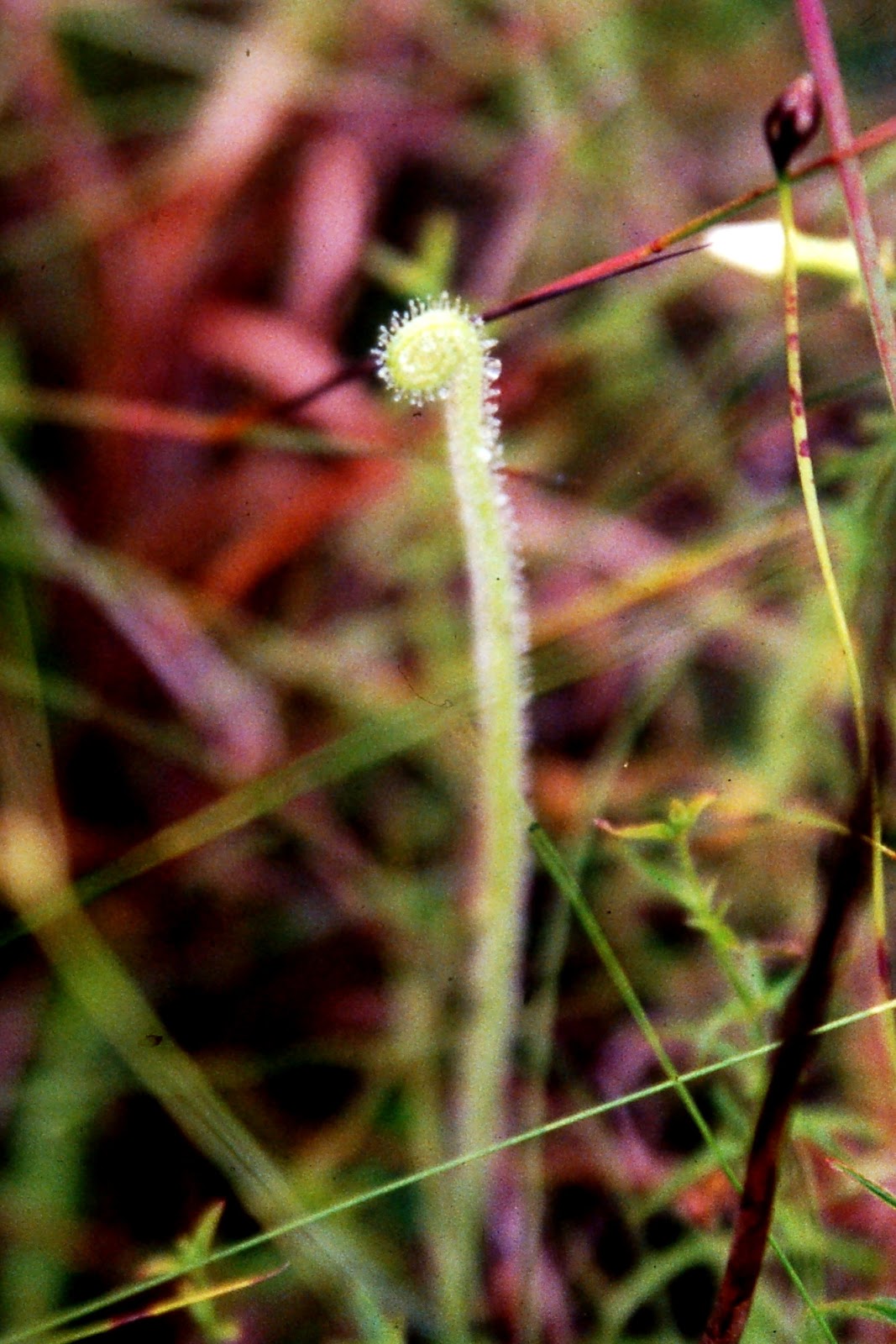
The leaves of Drosera tracyi and D. filiformis
unroll like the fiddleheads of a fern frond.

Pinguicula pumila is common in central
Florida and comes with white, bluish, or
purplish flowers.
The traps of Pinguicula are simple, sticky
leaves.
In the butterworts (Pinguicula), the leaves are covered with short glands which give them a sticky, fly-paper like coating.  The flowers are variously yellow, white, blue or violet, usually with a conspicuous nectar spur, and they live in wet to boggy soil.

Pinguicula caerulea has sky blue flowers.


The flowers of Utricularia inflata emerge from
star-like floating rosettes.  Large, highly-
dissected trap-bearing leaves are beneath.
A large population of Utricularia inflata
in a central Florida cypress swamp.
Utricularia subulata grows on wet sand,
often near Drosera capillaris.
Utricularia gibba is invisible until it sends
up its tiny yellow flowers.
The bladderworts (Utricularia) are the most numerous of Florida carnivores, with 14 species.  They get their name from the tiny bladder-like traps on their underwater or subterranean leaves.  These traps create a partial vacuum by actively pumping water out.  when tiny crustaceans brush against sensitive trigger hairs, they are sucked into the traps where they are digested.  Utricularia floridana, U. foliosa, U. inflata, and U. radiata are relatively large underwater plants, with just their flowers sticking up into the air.  U. olivacaea forms fine floating mats with tiny white flowers.  The others form their masses of traps in wet soil.  Bladderworts are cousins of the snapdragons and have similar yellow or purple flowers.