Showing posts with label Lotus. Show all posts

Friday, May 29, 2026

Plant Portraits 5. Lotus Here and There

  (Note images in this series were generated with the assistance of modern AI tools. No actual human individuals are portrayed here. See the first installment of the series for further explanation)

  From India to China, the lotus plant (Nelumbo nucifera) is considered sacred, or at least miraculous, because of its ability to rise from the mud, year after year, producing leaves and spectacular blossoms. In addition, its edible seeds and rhizomes are highly valuable sources of nutrition. Lotus occurs also in North America, with similar usage and respect by the indigenous people. Only the flower color is different. I presented some of this information in a previous post .

A group of Balinese dancers taking a break to admire lotus blossoms.

The lotus flower was associated with a number of Hindu deities. This newly created 
representation of the mythical birth of Goddess Padmavati from a lotus flower combines 
elements common to Indian art on this subject.
An indigenous Timacu family paddles through a pond filled with the Amerian lotus, 
Nelumbo lutea in Florida. From southern Ontario, Canada, to Florida, west to Oklahoma, 
and as far south as Honduras, the indigenous peoples made similar use of lotus as did Asian populations. 

 
Women and children in ancient China are harvesting the edible seeds of lotus in the Fall. The 
bitter-tasting embryos are removed, but saved for medicinal usage. In the winter, the more 
arduous task of digging up the edible rhizomes from the mud will be undertaken by men.


A chef in ancient China is slicing lotus rhizome for an upcoming meal.


NOT LOTUS! These are waterlilies of the genus Nymphaea. (Family Nymphaceae). They 
are not related at all to the lotus, which is genus Nelumbo (Nelumbaceae). The Nymphaeaceae 
is an ancient lineage branching off near the base of the angiosperm tree, while the Nelumbaceae 
is actually more closely related to sycamore trees in the Eudicots. I bring this up here to illustrate 
the very important concept of convergent evolution; plants from unrelated ancestors that have 
adapted to a similar habitat and lifestyle resulting in a superficial resemblance. 

Thursday, July 14, 2022

The incredible Lotus


 The lotus (Nelumbo nucifera) is an aquatic plant of great elegance, and one
Lotus plants fill a pond in Taiwan.

that is highly revered throughout southern and
eastern Asia particularly among Hindu and Buddhist cultures. Because the leaves and the flowers arise literally from the mud, appearing above the water clean and unstained, they are considered symbols of purity, strength and rebirth,. Wherever they can be grown, they are prized members of  aquatic landscapes. 

Religious figures are often depicted
as being borne (or sometimes born)
 on lotus flowers. From Wikipedia,
public domain.


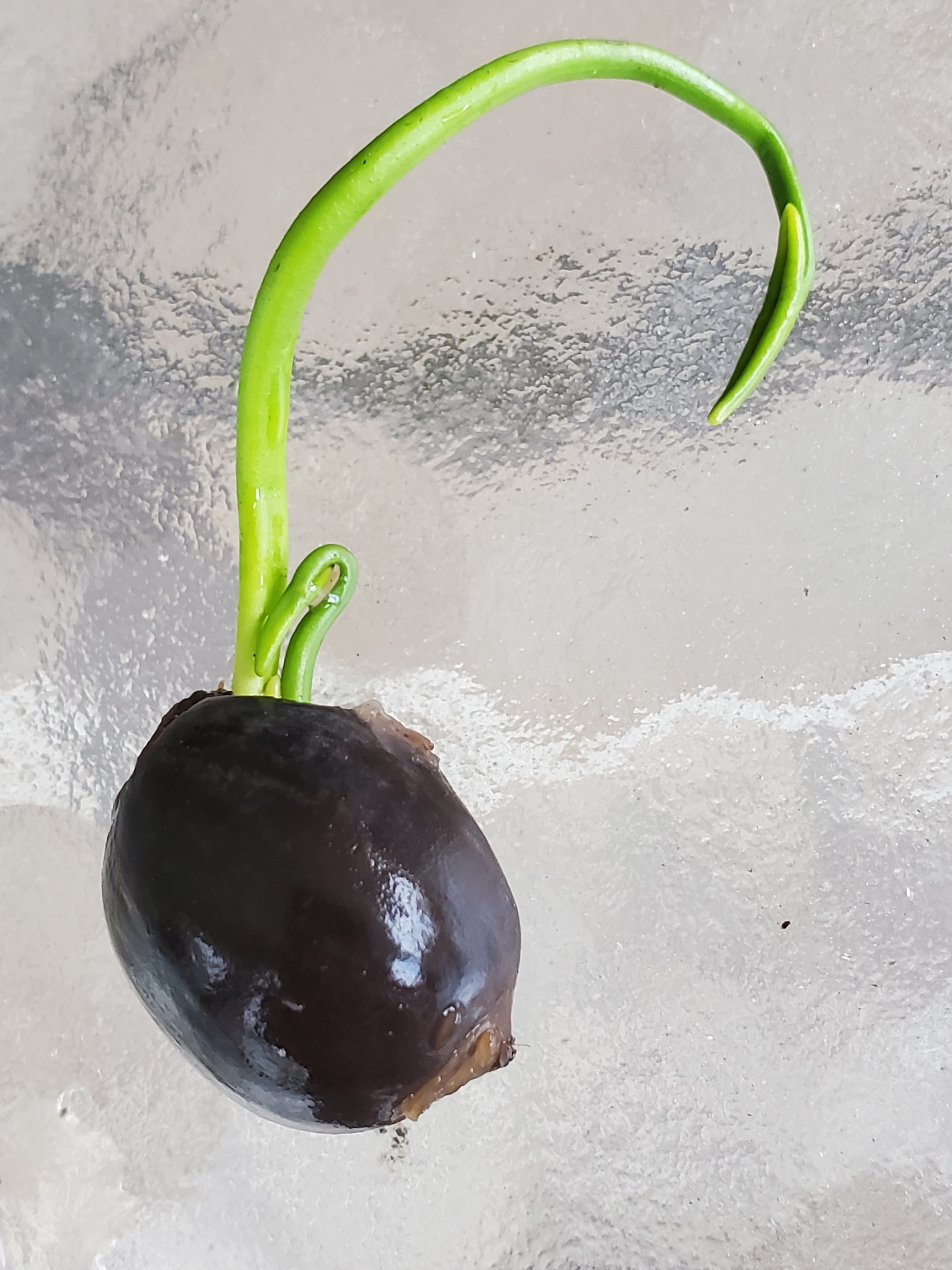
When a Lotus seed germinates, leaves
appear first, roots and rhizome will
emerge later.
I recently found lotus seeds for sale on the internet and decided to try growing them in a tub. I was astonished at how quickly they germinated and grew to maturity. It took less than a week  the seeds to sprout, wrapped in a wet paper towel in a plastic sandwich bag. I waited another week to stick them into the soil, eight inches below the water surface in the tub. The first leaf to emerge to the surface was about an inch across, but each succeeding leaf was a bit larger, and in a few weeks were more than a foot in diameter. They smallest leaves floated on the surface of the water, but later leaves pushed above the surface on sturdy stems. 

I planted the seeds in February, and by late May I was startled to see small flower buds appearing above the water, and these were fully opened in another couple of weeks. So, from seed to flower took scarcely three months. 

The solitary flowers of the Lotus rise to sit above the
leaves that are completely circular in outline.

Lotus plants are sometimes confused with waterlilies, which are in a completely different family. Their remarkable resemblance is a great example of convergent evolution. In waterlilies, however, leaves remain floating on the water surface, and have a deep cleft at the base. Waterlily seeds are borne in a series of separate carpels rather than a flat-headed structure. They are much slower in their growth also, taking three or more weeks to germinate and up to two years to form their first flowers. Waterlilies branched off from the earliest ancestors of flowering plants, while Lotuses are more closely related to Proteas and Sycamores.

Remarkably, though, they have similar pollination strategies. In both waterlilies and lotuses, insects, which often are bearing pollen from another flower, enter the flowers on the first day they are opened. In the evening the flowers close, trapping the insects. Flowers reopen the next day, and the pollen covered insects escape, to repeat the process in another flower.
As Lotus flowers fully open, the distinctive, flat-
headed receptacle, with young ovules embedded
in surface pits, are revealed.


Waterlily leaves have a cleft at the base, and their
separate carpels are hidden in a chamber below
the stamens.


The sacred Lotus of Asia has an American cousin,
Nelumbo lutea, which has yellow flowers. Photo
by Liz West, CC by 2.0.