Thursday, January 17, 2013

Papua New Guinea 4. North Coast to the Sepik River

The Sepik River is New Guinea's Amazon, and a popular tourist destination.  The broad ribbon of water winds through vast lowland rain forests and sago swamps.  I was privileged to be part of two expeditions to this northwestern section of Papua New Guinea, and as a palm botanist, was ecstatic to find a great variety of palms, many previously unseen and unnamed by western botanists.  The first trip was in 1971, as part of the field work for my graduate study of New Guinea palms.  The second was in 1978, which I'll reserve for my next post.
The Sepik River winds its way for
700 miles through
northwestern Papua New Guinea.

Our first stop was at Vanimo, near the border with the Indonesian half of the island, called Irian Jaya.  The island of New Guinea was divided into three parts by colonial European powers.  The western half was occupied by the Dutch, and it eventually became part of Indonesia.  The northeast was occupied by Germany, who lost it to the Australians after the World War I.  The southeast, known as Papua, was colonized by the British and later administered by the Australians.  The two eastern sections were united into the independent nation of Papua New Guinea in 1975.

The highlight of the Vanimo area was an extensive natural population of Pigafetta, a relative of sago palms and vining rattans, a group characterized by scaly fruits.  Our wanderings also led us to Wutung Village and the border with Indonesia.  
The trunks of Pigafetta filaris are remarkably
shiny.
The large inflorescence of Pigafetta contains hundreds of
flowers developing into scaly fruits.


A native of Wutung shows off his hand-made
hunting bow.


Your botany professor, impossibly young and
thin, at the marker of the border between
Papua New Guinea and Indonesia.


Turnera subulata, a native of central America, is cultivated
in Wutung.
Wild bird's nest fern (genus Asplenium) grows wild in
forests throughout New Guinea.
As we flew into the Sepik River basin in our tiny single-prop plane we could see vast populations of the sago palm, Metroxylon sagu.  We stopped at several places of somewhat higher ground to collect plants. We encountered many new palms, including a giant Orania near the village of Amanab.  I later named the species, Orania glauca.  The specific name refers to the waxy, or glaucous, covering of the inflorescence branches.
From the air we see that much of the Sepik Basin is occupied by vast stands of sago palm, Metroxylon sagu, which prefers swampy conditions.  The whitish-brown structures are the massive terminal inflorescences of the palms.  Each trunk blooms once, then dies.  As a build-up to the flowering phase, large quantities of starch are stored in the trunk.  This starch is harvested by the local people, and serves as their staple food.  

Orania glauca in forest near the village of Amanab.
Our local guide is dwarfed by the
inflorescence of Orania glauca.  Note
the whitish cast resulting from the waxy
coating.


The fruits of Orania are unusual among palms, in that up to
three one-seeded sections may form from a single flower.
Hydriastele valida was another new
species that we found.  This specimen
is growing near the village of Lumi.

This Rhopaloblaste species is similar to R. ceramica, otherwise known from the island of Ceram in Indonesia,
and differs from other New Guinea species by the pendulous (loosely hanging) leaflets of the fronds.
The bright red fruits of
 Rhopaloblaste cf. ceramica.


The branches of the Rhopaloblaste inflorescence
are tightly packed in bud, resembling a brain.
A lone specimen of an unidentified Livistona
near Lumi.

Thursday, October 11, 2012

Papua New Guinea 3: The Milne Bay Province


A coastal village on Normanby Island, with traditional thatch
houses on stilts, seems barely above sea level
New Guinea, though technically an island, is really more like a mini-continent.  It's varied terrain includes high mountains with permanent glaciers, tropical rain forests, and thousands of miles of coastline.  Much of that coastline is in the southeastern most province of Milne Bay, along its mainland peninsulas, fjords and bays, as wells around the numerous islands of the D'Entrecasteaux and Louisiade archipelagos that extend off to the southeast.  Some islands here are flat, some just tiny atolls.  Others are remnants of more massive structures of limestone or volcanic rock.

A young lady from the island of Panaete leans
against her palm-thatched house.
Here one finds the flavor of the south seas, where relatively recent settlers from Polynesia, Melanesia and Micronesia have made their homes, adding to the ancient cultural diversity of the country.  As elsewhere in remote parts of New Guinea, much of the traditional culture was intact in the early 1970's when I first visited.  Grass skirts were still the norm, but dresses, tee-shirts, and shorts were available from traders.  Houses were on stilts, built of local timbers and thatched with palm fronds, as they have been for thousands of years, and canoes were still being built the traditional way.

As usual, I will let the pictures themselves speak or of the botanical wonders to be found in this fascinating part of the world.
A traditional out-rigger canoe on Panaete Island
Some islands in the D'Entrecasteaux
Archipelago are tiny atolls.

The mainland coast near Tufi in the Milne Bay Province
 includes many fjords.
Villagers on Misima come out to meet the weekly boat.
The large orchid genus Dendrobium includes many species native to New Guinea.
This one, D. bracteosum is my favorite. I photographed it on Misima Island.


A wild Begonia from the forests of Misima
Island

Dendrobium atroviolaceum, also on
Misima,  is another common orchid in
 New Guinea.
A bird's-nest fern, genus Asplenium,
 grows on a tree
stump in the rain forest around Alotau,
on the mainland.

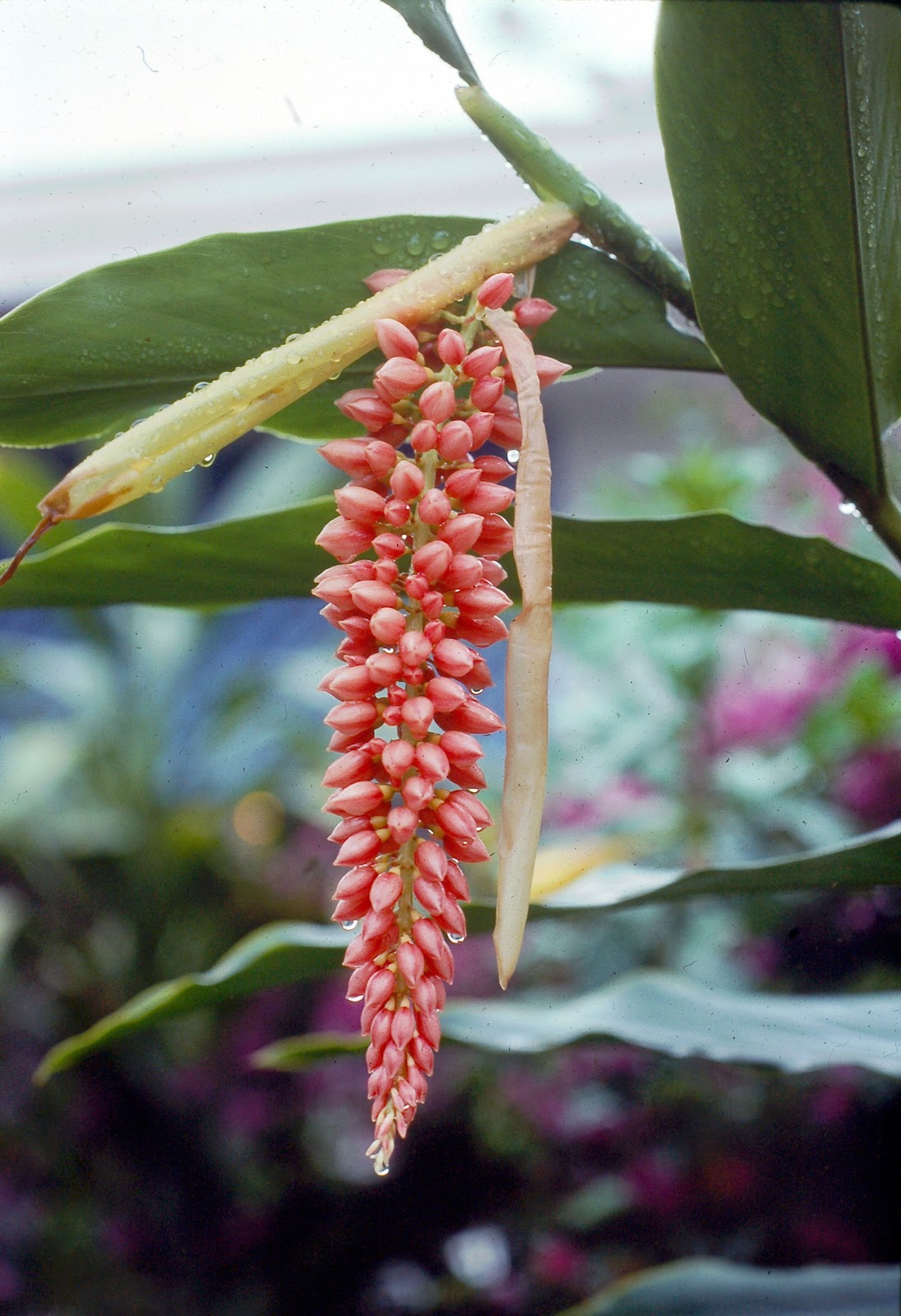
Members of the ginger family genus Riedelia have narrow,
tubular flowers probably pollinated by birds.


Several large individuals of Caryota rumphiana in a clearing on Misima.
A club moss, Lycopodium, spreads its
scaly branches in imitation of a fern
frond on Misima Island.
A small understory palm of genus Hydriastele
 on Misima.
Our local guide is dwarfed by the massive stilt roots of a giant screwpine
(Pandanus) in the mainland rain forest near Alotau.

Friday, August 10, 2012

Papua New Guinea 2: Aseki

A Kukukuku village, isolated on a mountain ridge top in the
Morobe Province
Although it didn't yield much in the way of wildflowers, a trip up to the village of Aseki, in the mountains above Lae, was one of the most fascinating encounters with a tribal culture.  This area is the home of the Kukukuku people, who had been quite isolated until about 10 years earlier.  They had in fact traditionally been feared by surrounding tribes for their vicious raids and cannibalistic practices.

Aseki is located among spectacular limestone mountains.
Two gentlemen from Aseki, the one
on the right in full traditional dress.
Both have a mouthful of betel nut.
A young woman with her child
watches the strange activities of
the pale-skinned botanists from
Lae.
The distinctive dress of both men and women consisted of a grass skirts, the men's skirts typically in a triangular shape, a bark cloth cape, and various necklaces including seashells acquired from coastal villagers. Men often had a piece of bone through their nasal septum. Men and women alike seemed to be constantly chewing betel nut, from the Areca catechu palm.

A recently deceased member of the
tribe sits in his airy coffin.
The Kukukuku neither buried nor cremated their dead.  Instead they dried them over a fire, and mounted the resulting mummies on stick pedestals in niches of the limestone cliffs.  It is said that this was so they could carry their ancestors with them when they moved to a new area.

Plant collecting in the area was successful for my colleagues from the Forestry Herbarium in Lae, Heinar Streimann and Peter Stevens.  Heinar would later move to Canberra, Australia, serving as the chief bryologist at the herbarium of the National Botanic Garden.  Peter had an illustrious career as a botanist at Harvard and later at the Missouri Botanical Garden, where he currently manages the successful Angiosperm Phylogeny Website, containing the most comprehensive and up-to-date information on the classification of flowering plants (http://www.mobot.org/MOBOT/Research/APweb/welcome.html).
Heinar Streimann (in back) and Peter Stevens press plant
specimens collected in the Aseki area.

Ptychococcus lepidotus growing in the
mountain forest. it can be found at
altitudes up to 3000 meters.
I also was able to collect material of some interesting palms, including Ptychococcus lepidotus, a species discovered and named by my mentor Hal Moore a few years earlier.  The fibrous trunks of this species are quite dense, and widely used in the New Guinea highlands for bows and spear heads. I also collected material from a very tall specimen of Gronophyllum that had been left in a clearing.
A lonely Gronophyllum chaunostachys remains where the forest has been cleared
for gardening. The genus has recently been combined with
the closely-related Hydriastele.

Sunday, July 29, 2012

Papua New Guinea 1. Lae and Bulolo

My aerial introduction to New Guinea included this view of the Markham River.
The town of Lae, capital of the Morobe Province, sits on the coast near the
mouth of the river.
This is the first of what will be many posts on my travels in Papua New Guinea.  Altogether, I spent about 14 months there, on three separate occasions, first as a graduate student in 1971-72, and later in 1978 and 1989.  I was there primarily to gather specimens and information on the many species of native palms.  Along the way, of course, there were many other botanical delights, as well as the diverse and fascinating people of the the country.

Metroxylon salomonense, with its massive terminal
bloom spike, was one of the palm prizes in the
Botanic Garden in Lae.  It comes from the Solomon
Islands, part of which lie within the nation of Papua
New Guinea. Various species of this genus, have
dense stores of edible starch in their trunks, and
are called Sagos.
I arrived at Cornell University in the Fall of 1969, to work under Dr. Harold E Moore, Jr., then the world expert on palms. He was about to submit a new research grant to the NSF, and so we sat down one day to discuss where I would like to do my doctoral research project.  Various parts of tropical America came up, but it was clear he was leaning toward New Guinea.  He had been there for a short visit a few years earlier, and could see that there was a great diversity of palms that were barely know.  I put up no resistance!  I had been fascinated with the south seas for years, having read the Mutiny on the Bounty trilogy and the Thor Heyerdahl books.  A graduation trip to Hawaii after high school only heightened my intrigue.

A New Guinea Impatiens, growing wild near
Lae.
The grant proposal was successful, and I set off for Papua New Guinea (the eastern half of the island) in the Fall of 1971.  The Australian administrators at the time had a well-developed network of patrol stations, there were good roads in some areas, and regular air flights and boats in other areas.  I was to work with the  Division of Forestry Herbarium in the northeastern port of Lae.  The legendary John Womersley, who had pioneered the modern botanical exploration of New Guinea, was the director, and would set up a number of field trips for me around the country.  The western half of the island, known then as West Irian, was part of Indonesia, and would be off-limits to me.  There were more political and social problems there at the time, and no botanical or governmental network to assist me there.

A wild ginger, in the genus Pleuranthodium,
growing near Lae.
The island of New Guinea, is more than an island, more like a small continent.  Nearly 1500 miles long from tip to tip, it has mountains more than 16,000 feet in elevation, some with permanent glaciers, despite being a few miles south of  the equator at its northwestern tip.  With 50 peaks more than 3750 meters (12,300 feet), the island provides much unexplored territory not only for biologists, but for mountain climbers as well. Tropical rain forest dominates the lowlands, but in the south, around the capital of Port Moresby, a long dry season limits the vegetation to a grassy savanna with scattered eucalyptus trees.  The mountain slopes support a gradation of montane rain forests, cloud forests, and alpine meadows.

Dancers at a "Sing-Sing" in Lae, with their spectacular headgear made of
bird feathers. Lae is home to several sing-sings each year.  The equivalent
of our state fairs, the emphasis is on dancing by local tribes, rather than
displays of chicken breeds and apple pie contests.
Another local tribe dons traditional dress and performs their
unique dance.
The mini-continent also is home to hundreds of ethnic groups, each with a unique language, and with varied physical features.  Most of the people superficially resemble Africans, but they are genetically and linguistically distinct.  The Papuans of the interior have roots on the island that go back thousands of years.  More recent immigrants, living in coastal areas and the many adjacent island chains are related to Melanesians, Micronesians and Polynesians in other parts of the Pacific.  I will introduce you to some of these people as I go about my botanical ramblings. Coastal peoples in general were brought into the fold of western civilization earlier, and in the 1970's many were educated and moving into the ranks of government officials, teachers, office workers, etc.  The peoples of more remote areas, particularly in the highlands, had managed to avoid much of the trappings of modern life up to that time, and many were still living as hunter-gatherers and farmers as they had for thousands of years.  Of course, really useful things like metal pots, pans, knives, and the occasional pair of trousers, had found their way to remote villages before the white faces of their would-be administrators.  In many places that I went, I was as much a curiosity to the locals as they were to me.
Bulolo lies in the mountains of Morobe Province, which in
1971 were still covered in forest.

To Bulolo

My first outing in Papua New Guinea was up to the mountain town of Bulolo, not far from Lae by road.  It wasn't so much to look for palms, but to tag along with a group of botanists from the Herbarium who had business at the forestry station up there.  It is a pleasant little town, and the cooler climate was was a welcome relief from the lowland heat.

A Nothofagus tree stand out in the
forest near Bulolo.
Out and about in the woods the flora was anything but tropical. Several species of Rhododendron were in bloom.  There are about 100 species in New Guinea, many of which have been introduced into cultivation.  Some interesting gingers, flowering vines and staghorn ferns were also to be seen.   In the northern hemisphere, we might expect pines and firs at this altitude, but here the only conifers are Araucarias.  The southern hemisphere  Nothofagus (in the oak family, Fagaceae) was also common on the hillsides.
Karl Karenga, who later became Director of the Division of Botany in Lae, shows off a massive staghorn fern (Platycerium sp.) growing at a field station near Bulolo.

Techomanthe dendrophila, or New Guinea trumpet vine,
 in the Bignoniaceae.
Rhododendron aurigeranum near Bulolo.

Rhododendron phaeochitum.

Rhododendron macgregoriae.
A series of stamps commemorating some of the native Rhododendrons was issued by Papua New Guinea.
A beautiful Pleuranthodium growing near Bulolo.
Massive prop roots emerge to support
a giant Pandanus tree.