Monday, April 16, 2012

Down the west coast of Mexico

Even before I was interested in plants, I had a fascination with the tropics.  Fueled by an  unhealthy diet of Tarzan books and movies, the Kon Tiki adventures of Thor Heyerdahl, Green Mansions, Mutiny on the Bounty, and countless others, it was all about the mystery, romance and glamour of the fictional tropics.   My Dad’s collection of National Geographic Magazines also aggravated my armchair exploration of the jungles of the Amazon, equatorial Africa, and the South Seas.  To me a tropical rain forest was a lush, green paradise, in which one frolicked, clad in nothing more than a loin cloth. 

I would eventually learn the truth when I began venturing out in search of rare tropical plants (or  in search of paradise - probably a bit of both).  I found that tropical rain forests are in fact steam baths, with muddy, slippery paths that perversely dump you at every opportunity into clumps of spiny vines.  The hostile natural inhabitants include every conceivable stinging, biting insect and venemous snake.  But by then it was too late.  I was hooked on tropical plants, particularly palms, and would later spend many years studying them. 

The tropics of western Mexico were a day’s drive from my home in southern California, and my Dad decided to drive me down the coast one winter break when I was in high school.  Later, I went down a couple of times more with friends from college.     These trips, and photos I'm sharing with you were all done in the 1960's, so things have undoubtedly changed since then.  I suspect that the rain forests are gone and the beaches of San Blas are lined by resort hotels.  A quick trip via Google Earth confirms the latter.  Some of the hilly areas still look pretty green, but I cannot confirm the status of the forest.

In southern Arizona and northwestern Mexico, the Sonoran
desert vegetation consists of xerophytic shrubs and the
abundant cholla cactus, Cylindropuntia echinocarpa.
The trip down gives quite an interesting sequence of climatic zones.  We usually entered Mexico via Nogales in Arizona. One goes first through the Sonoran desert, occupied primarily by sparse desert shrubs, like creosote bush and cholla cactus.  If it rains here at all, it's during the winter, so on these trips the foliage was fairly fresh. 

There is a gradual transition from there into progressively lusher vegetation.  Around the coastal town of Guaymas, a type of thorny scrub vegetation covers the hillsides.  After winter rains, wildflowers like morning glory and passionflower can be found among the shrubs. 
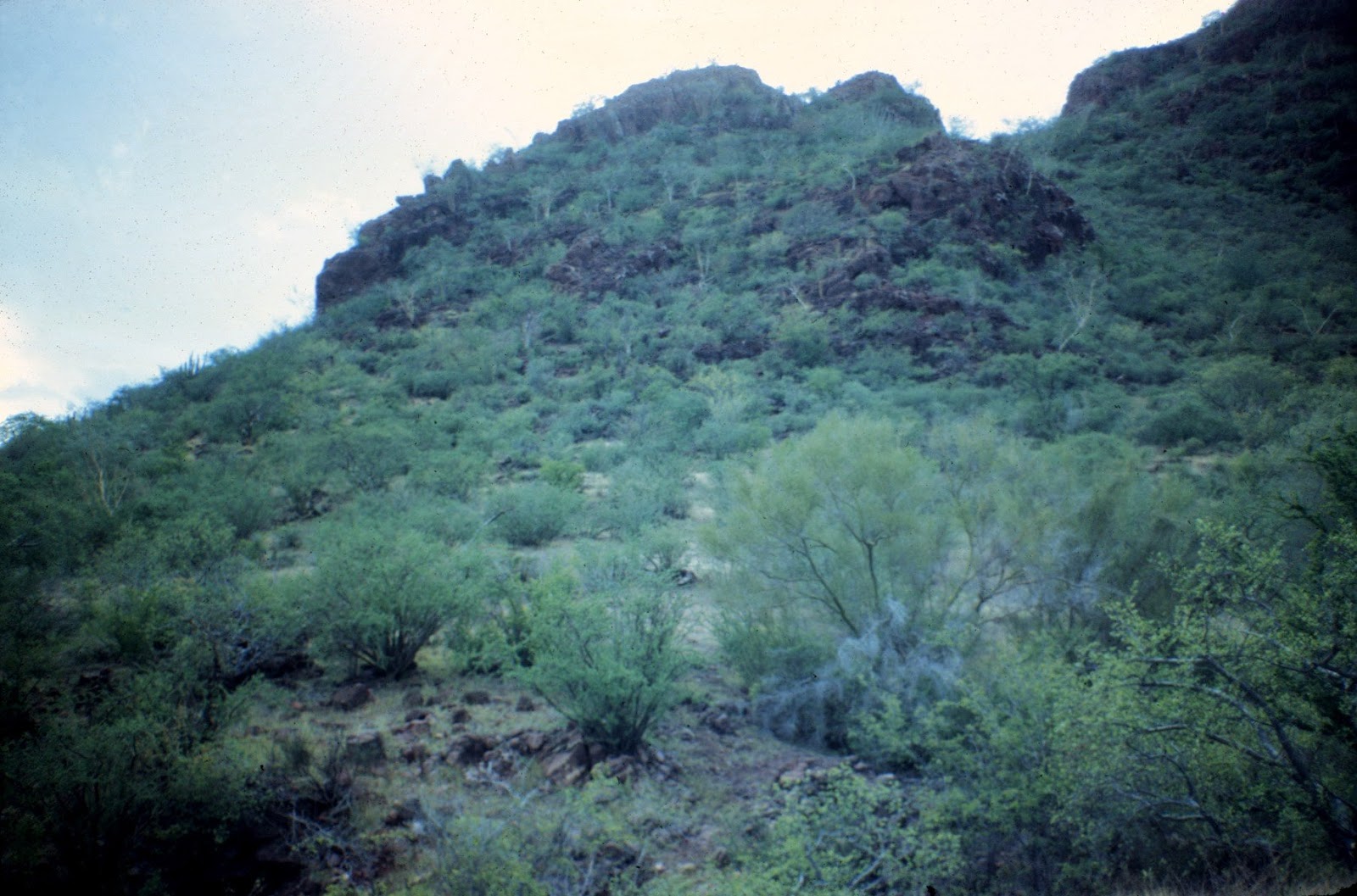
Near Guaymas, a lusher desert vegetation covers the hillsides.

An organ pipe cactus, Stenocereus thurberi
(or related species) is surrounded by grass
that grew lushly during the previous summer.
Further down, one enters the deciduous tropical forest, and we transition into the zone of summer rains and winter drought.  Here some epiphytic bromeliads and orchids are able to survive the dry season.  Tall grass and columnar cacti intersperse with the trees.   Large pink and yellow-flowering Tabebuia trees, which bloom during the dry season after their leaves have fallen, create technicolor splashes on the drab hillsides, and the morning glory trees are covered with white blossoms.
An unidentified epiphytic cactus in the dry forest of western
Mexico.

A hardy, epiphytic orchid in the decidous tropical forest.

The tree morning glory, Ipomoea arborescens,
blooms after its leaves fall in the dry season.
Epiphytic bromeliads survive on the branches of a Ficus tree
in the deciduous tropical forest.


A yellow-flowered Tabebuia blooms in the deciduous forest
during the dry season.

Sabal rosei palms are common in northwestern Mexico.
A Philodendron clings to a tree trunk in
the rain forest.
According to the vegetation maps, it’s supposed to be the same - dry deciduous forest - all the way down to the southern part of Mexico.  So it was quite a surprise to descend into a Pacific-facing valley near the town of San Blas and find the hillsides covered with a lush tropical rain forest.  Giant trees, probably related to the kapok tree, dominated the forest, but there were an extraordinary number of giant Attalea cohune palms as well.  Strangler fig Ficus trees, woody lianas, and large leaved Cecropia saplings were common as well. In the forest, philodendrons of several types climbed on the trees and exotic butterflies were everywhere.  Whether this is technically a true rain forest, I'm not sure, but it is evergreen, and surely a Tarzan-worthy jungle.  Butterflies were another of my interests at the time, and a number of them ended up skewered by mounting pins in my collection box.


The road from the highlands down to the coastal town of San Blas winds through
an evergreen tropical rain forest.


Cecropia saplings, with their large, umbrella-shaped leaves,
dominate an open ravine in the rain forest, while large Attalea
cohune palms rise on either side.

A strangler fig and lianas compete for
canopy space in the rain forest.

Barleria micans blooms at the base
of coastal cliffs near San Blas.


The coastline near San Blas was wild and little-visited in the
1960's


Tropical Mexico introduced me to many other delights, the most memorable to me being the delicious platano manzano, the apple banana.  Though tropical, the rain forest around San Blas was far enough north to be a bit cooler and drier than the rain forests I would later encounter in more equatorial forests.  So it wasn’t quite the bug-infested sauna that it could be, and it only enticed me to continue my explorations later in Costa Rica, Ecuador, and most of all Papua New Guinea, where I had the privilege to work for more than a year.
A girl does her laundry under a spreading Bouganvillea vine
in the town of San Blas.
Datura vines (Tomato family - Solanaceae) spread across the
sand near one of our camps. They are relatives of the Jimson weed, a source of hallucinogenic drugs.

Tuesday, March 13, 2012

California Mountain High

Growing up in the oven called California's "inland empire," the greatest refuge from summer heat was to drive up into the mountains.  The San Bernardino mountains were close and great for a weekend getaway, while the vast Sierra Nevada sat to the north, inviting us to more extended adventures. 

Mountains, of course, add a vertical dimension to vegetative diversity.  Plant geographers long ago noted that one could see very similar changes on a journey from sea level to the top of a high mountain as from the same point along the coast to the nearest pole.   In California, that means chaparral at sea level shifting gradually into pine forests at middle elevations, to alpine meadows above the tree line, and to bare rock and permanent snow fields at the highest elevations.  Such a vertical journey can be made vertically on foot in a day or two in California.

The journy toward the pole would of course take much longer, and the species would be different, but the feel and overall appearance is the same.  Heading north, you'd go from chaparral to redwood and douglas fir forests, then to spruce and fir forests in the north of Canada and Alaska, on into the treeless arctic tundra, and finally the polar ice cap. 
The yellow or ponderosa pine (Pinus ponderosa)  dominates
mid-elevation forests in the mountains of California, though a
number of other pines, as well as firs and spruces also occur in
these complex ecosystems.
It is always marvelous to enter into the shady pine forests: scattered groves of sugar pines at first, then the lofty groves of ponderosa pine, or in sheltered valleys in the Sierra, giant sequoias.  Ponderosa pines give away to lodgepole pines and firs further up, then the trees give way altogether to the alpine meadows. 

Of course, during the summer, the high mountain meadows fillwith wildflower treasures,  something different around every bend.

Lilium parryi can be found in moist soil along
streams and rivers.
I share with you here, in this third installment on California, some of my earliest botanical memories and photos. They are just a tiny sample of what one can find in the mountains, and I hope this will lure some of you into the mountains of the Golden State to experience them first hand. I will let each picture speak for itself.


Flowers of Primula suffrutescens poke up from their moist haven
between rocks.


The wallflower, Erysium perenne is a relative of mustard and
cabbage.
Ledum glandulosum (Ericaceae) brightens a sunny corner of the
mountain forest.
Lupines (genus Lupinus) fill an open spot among ponderosa
pines.
 

At higher elevations, the lodgepole pine (Pinus murryana)
replaces the ponderosa pines.
The shooting star, Dodecatheon alpinum is
common in open moist meadows.

Linanthus montanus makes a colorful splash in a dry meadow.
Gentians, like this blue Gentiana affinis are
always a treat. 
Erigeron peregrinus is a common member
of the sunflower family (Asteraceae)


This Eriogonum is a relative of buckwheat.

Phlox diffusa thrives in exposed rocky places
above the tree line.

Soil between rocks on the bare alpine slopes become flower
gardens during the summer.
Ranuculus eschscholtzii thrives in rocky
crevasses at higher elevations.
Aquilegia formosa is a jewel found in
moist places throughout the mountais of
California.
As the snow melts, the alpine meadows turn green, and wildflowers pop up from underground rootstocks and bulbs.

Near the summit of Mt. Whitney, the highest peak in California, all vegetation seems to disappear, except for the lichens and mosses able to cling to bare rock.

Friday, February 17, 2012

California's Desert in Bloom

Death Valley is one of the hottest, driest places in California. 
One would not expect to find much life here. Photo by F. C. Essig,
father of the author.
I continue my recollections of wildflower hunting in California with a trip to the desert. We think of deserts as desolate, bone-dry, oven-hot places, where camels trek across endless sand dunes in search of oases surrounded by date palms. California deserts are exactly like that, except that the native palms don't provide edible dates, there are more dry mountain ranges and rocky flats than sand dunes, the winters are colder, winter rain storms are more frequent, and there are only a few pet camels. 
In the rain shadow of the Sierra Nevada,
the floor of Death Valley is also the lowest
spot (282 feet (86.0 m) below sea level. 
Because there is no drainage, salt accumulates
and crystallizes in dry lake beds, such as
the "Devil's Golf Course," pictured here.
Photo by F. C. Essig

Along the saline waterways in Death Valley, salt-tolerant pickleweed (Allenrolfea occidentalis) and grasses fluorish.  Photo by F. C. Essig
Even in Death Valley, wildflowers can appear after rain.  This
Indian Paint Brush (Castilleja applegatei) grows on the hillsides above
the saline plain. (photo by F. C. Essig)
What people really don't expect in the desert are lush wildflower beds.  The winter rains that bring poppies and lupines to California hillsides occasionally make it over the mountains to the Colorado and Mohave deserts, bringing to life dormant bulbs, rootstocks, and seeds, resulting in some of the most spectacular displays in the state.  One of the best places to see desert wildflowers in all their glory is Anza-Borrego State Park.  This is in the Colorado (or Sonoran) Desert, where the winters are somewhat warmer and rainier than in the Mohave Desert to the north. 

The native fan palm of California (Washingtonia filifera) occurs in the canyon oases
of the California desert.  Photo by F. C. Essig
Bert Hunt and some students examine lupines blooming
beside the road.
Dr. Jaeger relaxes during a Palaver.
The desert was nearby when I was growing up in Riverside, California, and I was fortunate to have a dedicated teacher named Bert Hunt, who was avidly interested in everything, and would take groups of us to the deserts and mountains on field trips.  When I went to college at UC Riverside, I had the opportunity to learn more about the desert's secrets from plant taxonomy professor Frank Vasek and herbarium curator at that time, Oscar Clarke.  On several occasions, I also attended the famous "palavers" led by Dr. Edmund Jaeger.  These massive field trips/campouts in the desert were traditionally for "men only," which drove many young female botanists to disguise their feminine assets and observe the goings-on from the periphery.  It was an opportunity to learn from the "old man of the desert himself."  One of Dr. Jaeger's notable achievements was to document hibernation in birds, specifically the desert poorwill, for the first time.

Below are just a few of my ancient photos of the wildflowers of Anza-Borrego.  See much more at http://www.abdnha.org/pages/03flora/family/index.htm
Mimulus bigelovii, a desert monkey-flower,
blooms a few weeks after sprouting from a seed in
 the Anza-Borrego State Park.

Monptilon bellioides, the desert star, is another
quick-blooming annual in the sunflower family in Anza-
Borrego.
The desert lily, Hesperocallis undulata, emerges from
a bulb after a rainstorm.

A desert form of California Poppy.

Cacti, such as this Opuntia basilaris, are iconic members of
the desert flora, but only in the New World.  Cacti are not
naturally found in the deserts of Africa, Asia, or Australia, but
have escaped as weeds in a some places.  Cacti, and a few
hardy shrubs like Creosote Bush (Larrea divaricata) are
highly drought-resistant and remain green all year.


Wednesday, January 11, 2012

The Chaparral of California

For the current post, I return to my native California, and the dominant vegetation known as Chaparral.  Access the post through the following pdf file.


The Chaparral of California

Correction: the plant identified as Eriodyction crassifolium is actually Eriodyction parryi.

Thanks to Aaron Schusteff for the identification

Friday, December 16, 2011

The Pines of Rome

December is not really the time to go wildflower hunting in Italy, but I happened to be there for other reasons last week, and kept one eye on the lookout for things botanical.  Of course, Italy isn’t exactly buried in snow in December.  Except for the high mountains, the country enjoys a mild Mediterranean climate – there are palm trees all over the place!  So it’s like California or Florida; there’s always some kind of plant life.

The uniquely shaped pines of Rome, photographed
here in Florence,  are Pinus pinea.
Rome is sometimes referred to as the eternal city, and some of its most remarkably plants are eternal in the sense of being evergreen.  I have heard Respighi’s “Pines of Rome” many times, without really knowing what the big deal was, but upon actually seeing pines in Rome, I must say they are truly marvelous.  The common species is the umbrella pine, Pinus pinea, whose trunk branches into a unique rounded crown.   It is native throughout the Mediterranean region, and has been cultivated for 6000 years for its edible seeds.  Its presence turns any landscape into a classic work of art, especially when juxtaposed against small groves of Italian cypress.

Italian cypress trees mingle with olive trees
 near Florence.
Italian cypress, or Cupressus sempervirens, also has a unique shape: compact, upright, narrow, reaching for the sky.  It is often planted in cemeteries, not only for its heaven-aspiring posture, but also because the roots grow straight down and do not disturb graves.  It too is native throughout the Mediterranean region and Middle East, but seems to be especially characteristic of the Italian landscape.

The most common palm is the windmill palm, Trachycarpus fortunei, a native of China and one of the most cold-hardy palms (see “The many uses of Trachycarpus” in my publication list).   Along the coast are majestic specimens of the Canary Island Date Palm, Phoenix canariensis, which is a staple of the Riviera landscape.  A palm native to parts of the Mediterannean coastal scrub is the European Fan Palm, Chamaerops humilis, of which I think I got a glimpse from the bus as we headed for Pisa.  I’m sure that if we’d gone further south, we would have seen many more cultivated palms.
The windmill palm, Trachycarpus fortunei, on a hillside in Florence.

Olives ripen throughout the Fall in Italy.
December is the time for fruit.  There are ripening olives (Olea europea), as well as the bright red fruits of holly, Pyracanthus, and Nandina, not to mention the edible fruits of the tree strawberry, Arbutus unedo.  The bright red color of many of these fruits attracts hungry birds, who in exchange for the meal carry the seeds in their guts until they relieve themselves in a new location.
Holly berries ripen just in time for Christmas.


If I have the privilege of traveling again in this beautiful country, I will go after the winter rains, in March or April, which is truly the wildflower season.

 
The tree strawberry, Arbutus unedo.


Caper vines, Capparis spinosa, grow from cracks
in the wall of the medieval town of San
Gimignano. The flower buds of the caper are
used to spice up Italian foods.